
Livingston County Court Records After Arrest
The Livingston County arrest-to-court path starts with arrest by the sheriff, Kentucky State Police, or another officer. If the person is not cited and released, local custody or transport moves the person through the jailer system to a receiving jail. The first court stage is usually District Court, where misdemeanors, violations, traffic, arraignments, and felony probable-cause matters are handled. Felony cases can later move to Circuit Court after indictment or information.
Booking records and court records answer different questions. A jail record may show custody, booking time, arrest charge, bond, housing, or transport destination. A court record shows the case that follows the arrest: filed charges, docket settings, bond orders, prosecutor actions, warrants, dispositions, and record limits. For the custody side, use Livingston County jail inmate records; for booking photos, use Livingston County jail mugshots.
Livingston County Court Clerk
The local court record starting point is the Livingston County Justice Center. The Kentucky Court of Justice Livingston page identifies Circuit Court Clerk Debbie Knoth and gives the clerk phone as 270-928-2172. Kentucky Court of Justice says case-record requests start with the circuit court clerk in the county where the case was handled. Older files may be held in the clerk's office, at a record facility, or at the State Records Center if the clerk can identify the file locator data.
The Kentucky Court of Justice Livingston County page lists local court contact details, judges, schedules, and the Justice Center location.
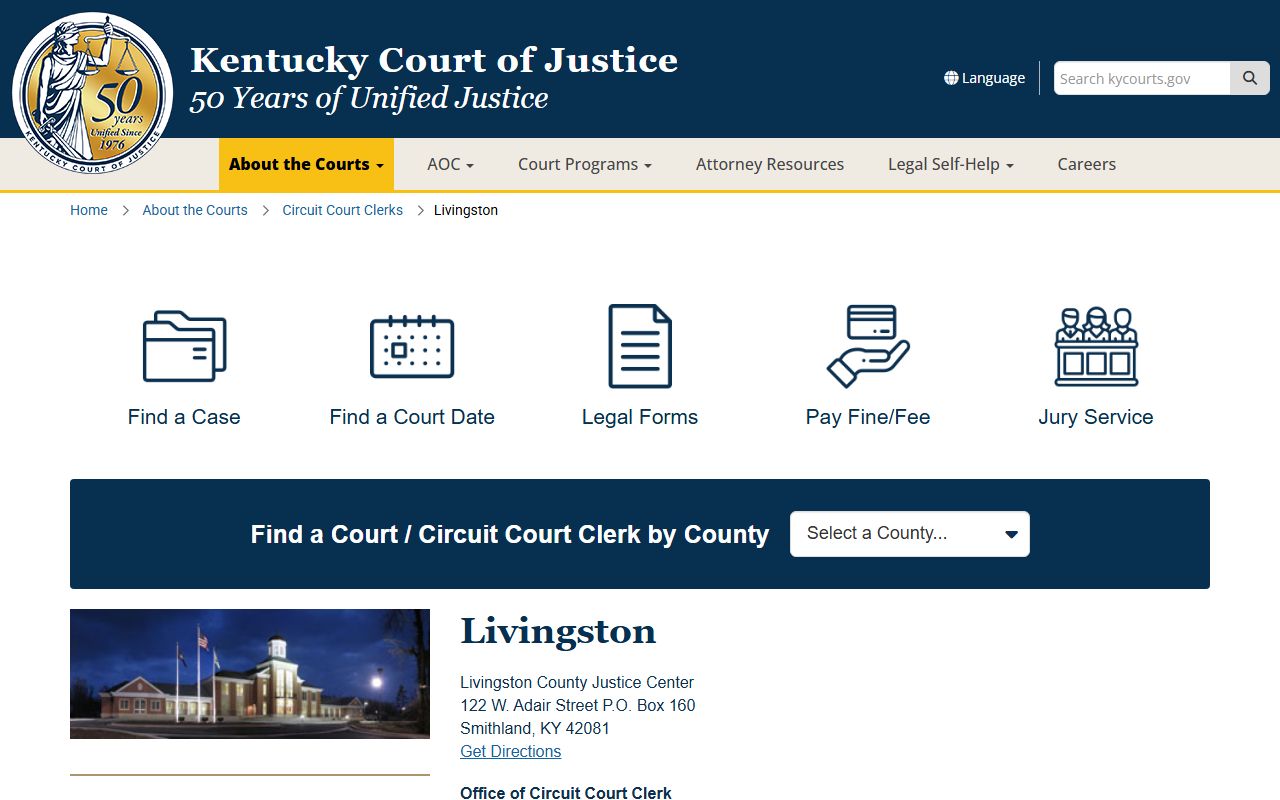
The court page is the local anchor for court records after a jail arrest because it identifies the clerk office tied to Livingston District and Circuit cases.
Find Livingston Court Records After Arrest
Kentucky offers a public docket portal for court schedules, but a docket is not the complete official case file. The docket helps locate a court date, county, division, courtroom, and case setting. The official record remains with the clerk. The KCOJ docket page also warns that docket information is subject to change and cannot be used for employment, licensing, or eligibility for government programs.
- Open the Kentucky Court of Justice docket portal and choose Livingston County.
- Select District or Circuit based on the type and stage of the case.
- Enter the court date and review courtroom or subdivision options if shown.
- Use the docket result to identify the case setting, then contact the clerk for official records.
- Use KYeCourts guest access where available for broader eCourt lookup options.
The Kentucky Court of Justice docket portal is the public schedule search used for Livingston County court settings.
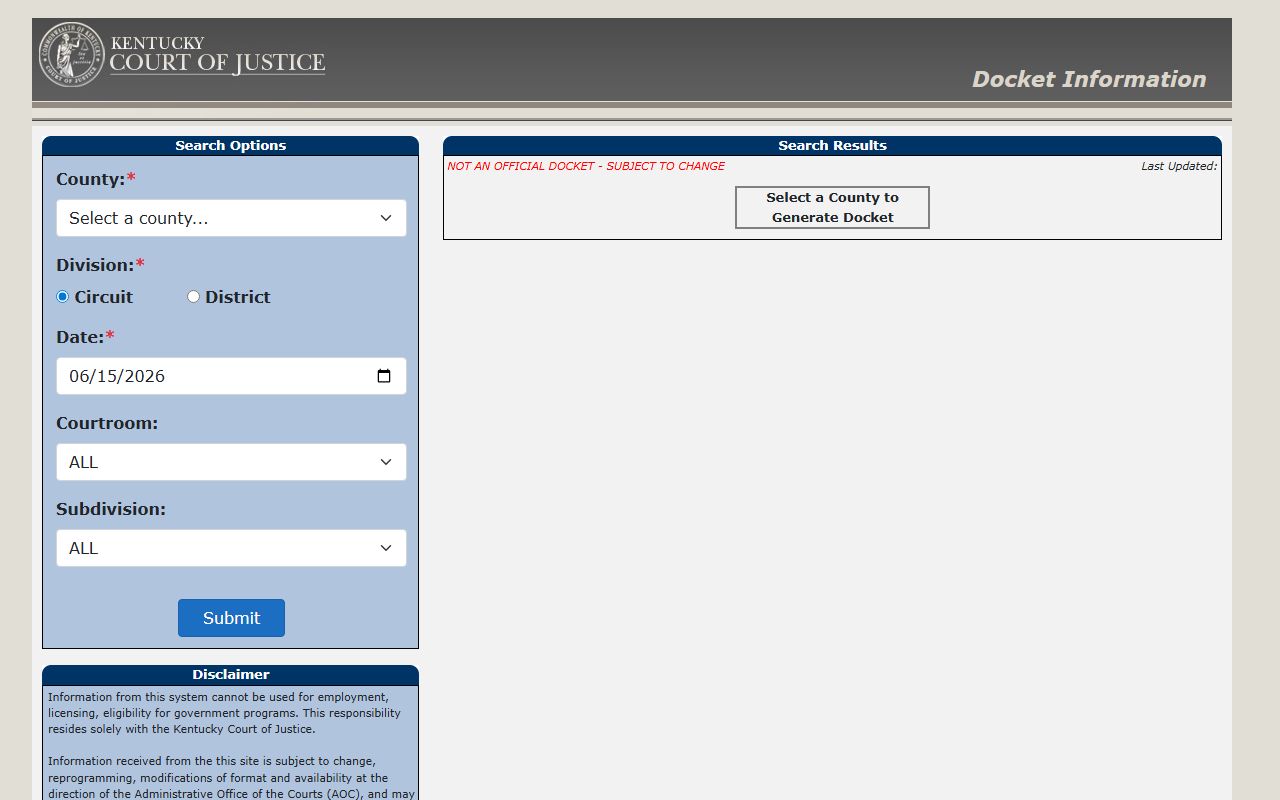
The docket search is useful for finding hearings after a jail arrest, but it should not be treated as the full case file or a criminal-history report.
| Field Label | Type | Required | Options / Format Notes |
|---|---|---|---|
| County | Dropdown | Yes | Choose Livingston. |
| Division | Radio or dropdown | Yes | District or Circuit. |
| Date | Date | Yes | Use the court date being checked. |
| Courtroom | Dropdown | Varies | ALL may appear as an option. |
| Subdivision | Dropdown | Varies | ALL may appear as an option. |
Charging Documents After Arrest
After a Livingston County arrest, the charge label can change as the case moves from jail intake into court. The prosecutor may amend, reduce, dismiss, or replace the arrest charge. Felony prosecution for the 56th Judicial Circuit is handled by the Commonwealth's Attorney covering Caldwell, Livingston, Lyon, and Trigg counties. County-level and lower-level matters can involve the Livingston County Attorney.
| Document | Who Uses It | What It Does |
|---|---|---|
| Complaint | Officer or prosecutor | Starts a case with a sworn allegation or charging statement. |
| Information | Prosecutor | Files a charge in court without a grand-jury indictment when allowed. |
| Indictment | Grand jury | Formal felony charging document that moves a case into Circuit Court prosecution. |
Livingston Court Charge Status
Charge status tells where a court record stands, not where the person is housed. A pending charge means the case is still open. An amended or reduced charge means the court record no longer matches the original arrest label. A dismissal means that charge did not proceed to conviction. A warrant or failure-to-appear entry can bring the person back into custody and create a new booking event.
| Status | What It Means |
|---|---|
| Pending | The court case or charge is still active. |
| Amended | The prosecutor or court changed the charge from the original label. |
| Reduced | The charge was lowered in level or replaced with a lesser offense. |
| Dismissed | The charge was ended without a conviction on that count. |
| Disposed | The charge has reached a final case outcome. |
Bond Orders After Arrest
Bond is set through Kentucky courts, not by a private roster. A newly arrested person may receive a bond amount after first appearance or under an applicable order. The receiving jail roster may show a bond field, but the formal source is the court order or case record. Holds can block release even when a local bond appears payable.
| Bond Type | How It Works |
|---|---|
| Cash bond | Full amount paid in cash or allowed funds. |
| Surety bond | A bail agent posts bond for a fee where permitted. |
| Property bond | Property may secure release if the court accepts it. |
| Unsecured / PR bond | The person signs a promise to appear without depositing full cash. |
| No-bond hold | Release is blocked unless a court or holding agency clears the issue. |
Warrants and Court Records
No official Livingston County sheriff active-warrant search was located. The public path is phone and court based. Call the Livingston County Sheriff's Office for local warrant-service questions, contact the Circuit/District Court Clerk for case and court-date information, and use KCOJ dockets for upcoming court appearances. KYeCourts guest access may help where available. Commercial warrant-search pages should not be used as the source for a court record.
- Arrest warrant
- Court order authorizing an arrest.
- Bench warrant
- Warrant issued by a judge, often after a missed court date.
- Search warrant
- Order authorizing a search, not the same as an arrest warrant.
- Fugitive hold
- A hold tied to another jurisdiction's case.
Charges vs Convictions
Being arrested or charged is not the same as being convicted. A charge is an accusation carried in a court record. A conviction follows a guilty plea, verdict, or other final finding. A booking entry may still show an arrest charge even after the prosecutor files a different charge. The formal case record controls the court status.
| Charge | Conviction | |
|---|---|---|
| Stage | Accusation or filed count | Final finding or plea outcome |
| Proof level | May begin with probable cause | Requires plea, verdict, or other legal finding |
| Can change | May be amended, reduced, or dismissed | May be appealed, vacated, or expunged only if law allows |
Sealed and Expunged Records
Kentucky law allows some records to be vacated or expunged, but eligibility depends on the charge, outcome, timing, and statute. KRS 431.073 is the felony expungement statute cited in the research. Expungement is a court process, not a request to a search site. A sealed or expunged court record can also affect whether related public booking material remains easy to find.
| Sealed | Expunged | |
|---|---|---|
| Public view | Hidden from ordinary public access | Vacated or removed from public treatment if granted |
| Process | Requires a court order or legal rule | Requires an eligible petition and court approval |
| Limits | Some agencies may retain restricted access | Not every charge or conviction qualifies |
Restricted Livingston Court Records
Kentucky public access is broad, but not unlimited. Juvenile matters, sealed cases, certain dismissed or expunged records, medical information, confidential victim data, and records tied to active investigations may be limited. Docket portals are public search tools, but the clerk's office remains the source for official copies and case-file questions.
For a statewide criminal-history style report, Kentucky Court of Justice offers FastCheck and one-time request options. Those reports are different from a docket search and may require the requestor's details. Any use for employment, tenant screening, credit, insurance, licensing, or similar purposes must follow the proper legal channel.
Important: Public docket details are not a consumer report and should be verified with the Livingston court clerk.